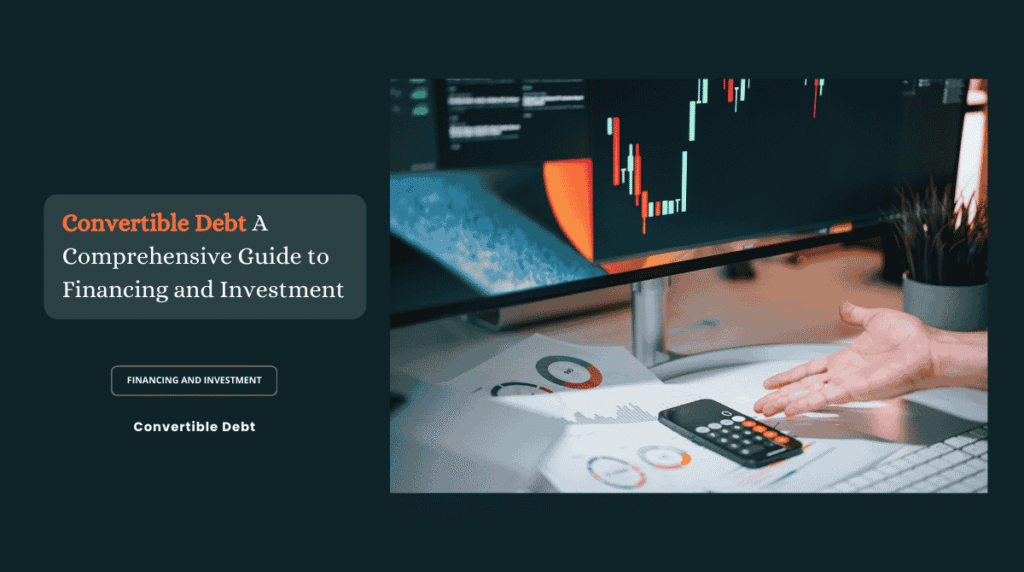
What Is Convertible Debt? Convertible debt refers to a financing method where investors lend money to a company with the option to convert that debt into equity (usually shares) at a later date. This arrangement blends features of both debt and equity, making it an appealing choice for early-stage businesses and investors.
For businesses, convertible debt provides a way to secure funding without immediately giving up ownership or control. For investors, it offers the possibility of converting the loan into equity at a later stage, often at favorable terms. This can lead to substantial returns if the business grows and performs well.
Convertible debt is typically used in seed or Series A funding rounds, especially when determining a company’s valuation is difficult. It gives investors the chance to lend money and gain equity once the company reaches a more precise valuation.
Why Opt for Convertible Debt?
Convertible debt offers multiple benefits for both businesses and investors. Below are some key reasons why it’s a popular choice:
For Startups:
- No Immediate Dilution: Convertible debt lets companies raise capital without giving away equity or control upfront.
- Simplified Terms: Negotiating simplified terms is often easier than traditional equity financing, as there’s no immediate need to agree on a valuation.
- Lower Interest Rates: Since investors can convert their debt into shares, the interest rates are usually lower than those for traditional loans.
For Investors:
- Potential for High Returns: If the company performs well, converting the debt into equity can lead to a greater return than traditional debt repayment.
- Favorable Terms: Investors often enjoy advantages like discounts on future equity prices or valuation caps that protect them from excessive valuations in later funding rounds.
- Early Access to Growth: It offers investors the chance to get in on the ground floor of a potentially high-growth company.
Features of Convertible Debt
Convertible debt is distinct from both traditional loans and equity financing due to its unique structure. Some of its key features include:
| Feature | Description |
|---|---|
| Principal Amount | The amount of money lent to the company, which will later convert into equity under specified conditions. |
| Interest Rate | Typically lower than regular debt, this is the rate at which interest accrues on the loan. |
| Maturity Date | The date by which the debt must be repaid if it has not converted to equity. |
| Conversion Terms | Conditions under which the debt is converted into equity, including discounts and valuation caps. |
| Valuation Cap | The maximum valuation at which the debt can convert into equity, protecting investors from high valuation rounds. |
| Discount Rate | A percentage discount on the price per share at the time of conversion, often ranging between 10% and 30%. |
How Does Convertible Debt Work?
Let’s break down the steps of how convertible debt works in practice:
- Initial Loan Agreement: Investors lend money to the company, with an agreement that the debt can convert to equity in the future.
- Trigger for Conversion: Typically, the debt converts into equity when the company raises additional funds, such as a Series A round.
- Conversion Process: The loan amount converts into equity at a discounted price or a valuation cap, depending on the terms.
- Repayment or Conversion: If the company doesn’t raise funds by the maturity date, it may be required to repay the debt. However, if a funding round occurs, the debt will likely convert into equity.
For a detailed breakdown, refer to our article on Convertible Debt Expense.
Example of Convertible Debt in Action
Imagine a startup raises $100,000 through convertible debt with these terms:
- Valuation cap: $5 million
- Discount rate: 20%
- Interest rate: 5% annually
- Maturity date: 2 years
After 2 years, the company raised a Series A round with a $10 million valuation. The investor’s debt will convert into equity at the $5 million cap or with a 20% discount on the new Series A price per share, whichever is more favorable to the investor.
The valuation cap ensures the investor gets a better price for their equity, as they are effectively buying shares as though the company were worth $5 million instead of $10 million.
Benefits of Convertible Debt for Startups
Startups widely favor convertible debt for several reasons. Here are the primary benefits for businesses:
- No Immediate Dilution: Startups can raise funds without immediately giving up ownership. This is especially important when the company’s valuation is not yet precise.
- Faster Negotiations: Since no valuation is set at the outset, it speeds up the process of securing capital. The focus is on the terms of the loan, which simplifies negotiations.
- Lower Legal Costs: Compared to traditional equity funding, convertible debt agreements are often simpler, reducing legal fees and administrative costs.
- Flexibility: If a startup is unable to secure follow-up funding by the maturity date, they may be able to renegotiate the terms of the debt or, in some cases, repay the loan.
Advantages for Investors
For investors, convertible debt provides an opportunity to access high-growth businesses early on. Here are some key benefits for investors:
- Upside Potential: If the company grows and becomes more valuable, investors can convert their loan into equity at a favorable price, which can yield a much higher return than traditional debt.
- Downside Protection: As creditors, investors are typically paid before equity holders in case of liquidation, offering some protection against loss.
- Discounted Equity: The debt usually converts into equity at a discount to the price of shares in the next funding round, giving investors better terms than later investors.
- Priority in Liquidation: Convertible debt holders are generally higher up in the hierarchy during liquidation, meaning they are more likely to recover their investment if the company fails.
Challenges of Convertible Debt
While convertible debt has advantages, it’s essential to recognize the potential downsides for both companies and investors.
1. Repayment Obligation
If the company doesn’t raise a subsequent round of funding by the maturity date, the startup may be required to repay the debt, which can put financial pressure on the company.
2. Potential for Significant Dilution
For founders, convertible debt can result in significant dilution of ownership if a large amount of debt converts into equity, especially in subsequent funding rounds.
3. Complex Terms
The terms surrounding convertible debt—such as discounts, valuation caps, and conversion triggers—can be complicated. Both parties need to fully understand these conditions to avoid potential issues down the line.
4. Misaligned Interests
As convertible debt turns into equity, there is the potential for misalignment between the interests of early investors (who may be seeking a quicker return) and later investors or the company’s leadership (who may be more focused on long-term growth).
Convertible Debt vs. Equity Financing
Convertible debt is often seen as a more flexible alternative to traditional equity financing. Here’s how the two compare:
AspectConvertible DebtEquity Financing
Ownership Dilution: No immediate dilution for the company until conversion. Immediate dilution of ownership when shares are issued.
Investor’s Risk: Debt holders have priority over equity holders in liquidation. Equity holders face a higher risk in the case of liquidation.
Interest Rate Interest is typically charged on the loan. No interest charged.
Conversion Terms: Debt converts to equity at a later stage under agreed terms. No conversion—equity is issued to investors at the outset.
Speed of Negotiation: Faster to arrange and less complex. Requires more negotiation and legal documentation.
Repayment Debt must be repaid if conversion does not occur. No repayment is required.
Conclusion
Convertible debt serves as a versatile financing tool, offering benefits to both companies and investors. However, it’s essential to understand its mechanics, advantages, and potential drawbacks before engaging in such arrangements.
For more insights into financial instruments and strategies, explore our Finance Category.
FAQs
What happens if the company doesn’t raise more funds?
If the company doesn’t secure further funding by the maturity date, the debt may need to be repaid. Some agreements may allow the debt to convert into equity in this situation, but repayment is still a possibility.
How is the discount rate applied in convertible debt?
The discount rate gives early investors a percentage off the price at which the debt will convert into equity. For example, if the next round of funding prices shares at $10 per share, a 20% discount allows the investor to purchase shares at $8 each.
What is a valuation cap, and why is it important?
A valuation cap limits the price at which convertible debt converts into equity. Suppose the company raises funding at a higher valuation. In that case, the cap protects the investor from paying too much for the shares by allowing them to convert at the lower capped valuation.
What risks do investors face with convertible debt?
Investors face risks, including the possibility of not converting to equity if the company fails to raise additional funds. There is also a risk of dilution if the company raises substantial funds in later rounds.
Why is convertible debt commonly used in early-stage funding rounds?
Convertible debt allows companies to raise capital quickly without having to determine their valuation right away. This makes it a practical choice in the early stages when valuation is uncertain and can change rapidly as the company grows.