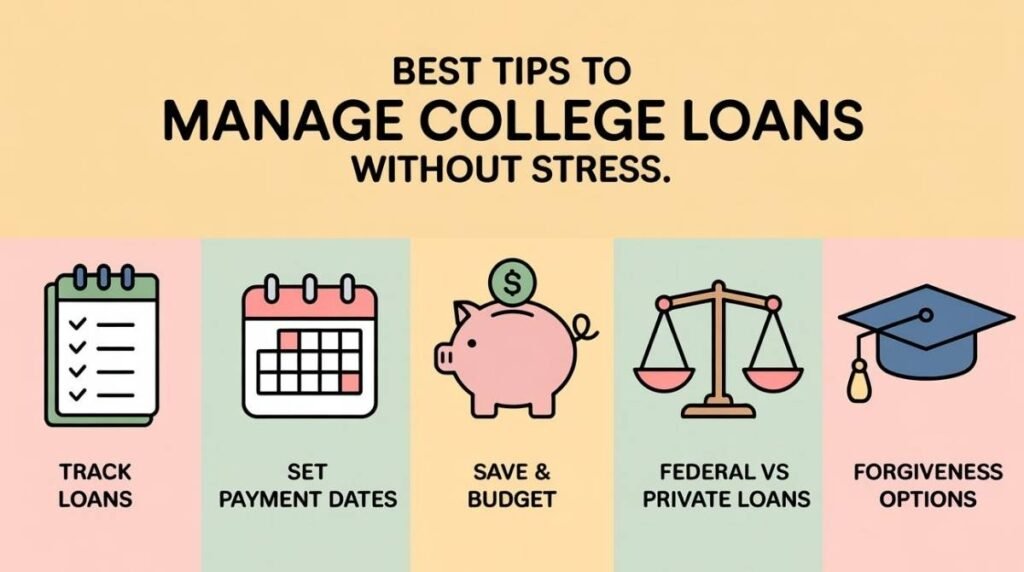
Navigating the world of college loans after graduation feels overwhelming for many. A clear management strategy eliminates this financial anxiety. Your student loans are a manageable part of your budget. Proactive steps can streamline your repayment process. This approach turns a source of stress into a structured plan.
Effective management starts with knowing your loan details. You must understand your loan servicer and repayment options. Federal and private college loans have different rules and benefits. We will outline practical steps for organizing your debt. These tips help you build a confident financial future.
Building Your Personal Loan Inventory
You cannot manage debt you do not understand. Create a complete list of all your college loans. This inventory is your financial foundation. It clarifies your total balance and individual loan terms.
- Find Federal Loans: Use your FSA ID to log into StudentAid.gov. This site lists all your federal student debt.
- Locate Private Loans: Check your credit report at AnnualCreditReport.com. Your report shows all open loan accounts.
- Record Key Details: For each loan, note the loan servicer, current balance, interest rate, and repayment status.
Understanding Your Loan Servicer’s Role
Your loan servicer is the company handling your billing. They manage your payments and answer questions. Communication with your servicer is critical. Always update them with your current contact information. They can help you navigate forbearance, deferment, and repayment plans.
Selecting the Optimal Federal Repayment Plan
Federal college loans offer multiple repayment plans. Choosing the right one minimizes your monthly financial pressure.
Standard Repayment Plan
This plan sets payments to pay off your loan in 10 years. It has the highest monthly payment. You will pay the least interest over time.
Graduated Repayment Plan
Payments start lower and increase every two years. This plan also spans 10 years. It suits borrowers who expect their income to grow.
Income-Driven Repayment (IDR) Plans
These plans base your payment on your income and family size. They are essential tools for managing financial hardship.
- Income-Based Repayment (IBR)
- Pay As You Earn (PAYE)
- Revised Pay As You Earn (REPAYE)
- Income-Contingent Repayment (ICR)
IDR plans can significantly lower your monthly payment. Any remaining balance may be forgiven after 20 or 25 years of qualifying payments.
Comparing Federal Repayment Options
This table helps you visualize the key differences between common plans.
| Repayment Plan | Monthly Payment | Plan Duration | Best For |
|---|---|---|---|
| Standard | Fixed, higher amount | 10 years | Borrowers who can afford the payment and want to save on interest. |
| Graduated | Starts low, increases | 10 years | Those with a starting salary who expect steady income growth. |
| Income-Driven (IDR) | 10-15% of discretionary income | 20-25 years | Borrowers with high debt relative to income or those seeking PSLF. |
Strategies for Managing Private Student Loans
Private college loans lack the flexible options of federal loans. Their terms are set by the bank or lender. You must still develop a proactive strategy.
Contact Your Lender Directly
Explain any financial difficulties you face. Some private lenders offer temporary hardship programs. These may include interest-only payments for a short period.
Refinance Your Private Loans
Student loan refinancing involves a new private loan. It pays off your existing loans. The goal is to secure a lower interest rate or better terms.
- Best for: Borrowers with a strong credit score and stable income.
- Consideration: Refinancing federal loans into a private loan makes you ineligible for IDR plans and loan forgiveness.
Proactive Steps to Reduce Total Interest
The total cost of your college loans depends heavily on interest. Smart tactics can save you thousands of dollars over the loan’s life.
- Make Slight Overpayments: Paying even $25 extra each month reduces your principal faster.
- Target High-Interest Loans First: Use the debt avalanche method. Put extra payments toward the loan with the highest interest rate.
- Set Up Autopay: Most loan servicers offer a 0.25% interest rate discount for automatic payments.
Accelerated Payoff vs. Minimum Payment
The table below shows the power of paying more than the minimum.
| Scenario | Total Loan Balance | Interest Rate | Monthly Payment | Payoff Timeline | Total Interest Paid |
|---|---|---|---|---|---|
| Minimum Payment | $30,000 | 5% | $318 | 10 years | $8,168 |
| +$50 Extra/Month | $30,000 | 5% | $368 | 8 years, 5 months | $6,650 |
| Net Result | – | – | – | 1 year, 7 months sooner | $1,518 saved |
Navigating Public Service Loan Forgiveness (PSLF)
The Public Service Loan Forgiveness program forgives federal student debt. You must work full-time for a qualifying employer. This includes government and non-profit organizations.
PSLF Requirements:
- 120 qualifying monthly payments.
- Employment with a qualifying employer.
- A specific federal loan type (Direct Loans).
- An eligible Income-Driven Repayment plan.
The program is complex but valuable. Use the PSLF Help Tool on StudentAid.gov to track your progress. Submit the Employment Certification Form annually to avoid surprises.
Preventing Loan Default and Its Consequences
Default is a severe outcome for mismanaged college loans. It occurs after approximately 270 days of non-payment for federal loans. Default damages your credit score and triggers serious financial penalties.
Consequences of Default:
- Wage Garnishment: The government can take money directly from your paycheck.
- Tax Refund Offset: Your federal and state tax refunds can be seized.
- Collection Fees: You become responsible for significant collection costs.
- Loss of Federal Benefits: You lose eligibility for additional aid and benefits.
Options If You Are Struggling to Pay
You have options if you cannot afford your payments. Act quickly to avoid default.
- Switch Your Repayment Plan: Move to an Income-Driven Repayment plan for a lower payment.
- Request Deferment or Forbearance: These options temporarily pause your payments. Interest may still accrue.
- Loan Rehabilitation: This process can remove a default status from your credit report.
Conclusion
Managing your college loans without stress requires a plan and consistent action. Start by organizing your loan details. Choose a federal repayment plan that fits your budget. Explore forgiveness programs if you qualify. Simple strategies like making extra payments can save you money. Your student debt is a manageable financial commitment.
[Learn more about different types of educational funding options in our Student Loan Guide]
Frequently Asked Questions
Should I consolidate my federal student loans?
Federal loan consolidation combines multiple loans into one. It simplifies payments and can provide access to more repayment plans. However, it may reset the clock for certain forgiveness programs. Weigh the pros and cons for your specific situation.
What is the difference between loan deferment and forbearance?
Both allow you to temporarily stop payments. Deferment is preferable for certain federal loans because interest does not accrue on subsidized loans. In forbearance, interest accrues on all loan types, increasing your total balance.
Can my student loans ever be discharged?
Student loan discharge is rare. It can occur in specific situations like total and permanent disability, the closure of your school, or under the Borrower Defense program. College loans are generally not dischargeable in bankruptcy.
How does marriage affect my income-driven repayment plan?
For most Income-Driven Repayment plans, your spouse’s income will affect your payment calculation if you file your taxes jointly. If you file separately, your payment is based solely on your income. You should calculate both scenarios during tax planning.
What happens if I just ignore my student loans?
Ignoring your student loans leads to default. This has severe financial consequences, including wage garnishment, damaged credit for years, and the addition of large collection fees. It is crucial to communicate with your loan servicer to find a solution.