When the term “sales enablement” enters company discussions, it signals a shift toward empowering sales teams with the resources, processes, and tools that enable them to close more deals. For many organizations, this shift means aligning marketing, product, and sales operations under a unified agenda.
In my ten years as a U.S. consular editorial specialist advising business‑readiness and strategy communications, I’ve observed how clarity in enablement dramatically influences outcomes. In this article, I combine best-of-breed tactics and fill gaps often overlooked by mainstream blogs. My analysis will help you implement sales enablement in a way that drives revenue, optimizes budget, and aligns your workforce.
1. Setting a Clear Enablement Foundation
Before diving into tools and tactics, a robust sales enablement foundation must be laid. This groundwork addresses mission, roles, and metrics.
- Define the purpose of enablement: Is it to boost new business, retain clients, or expand existing accounts?
- Identify key stakeholders, including sales leaders, marketing, product teams, and sales operations.
- Clarify roles and responsibilities: Who owns the content, who trains the representatives, and who measures success?
- Set upfront success criteria: Deal size growth, win‑rate lift, shortened sales cycle.
This phase ensures sales enablement is more than a collection of resources—it’s a structured engine. It prevents disparate efforts and encourages ownership and clarity.
2. Aligning Processes Across Departments
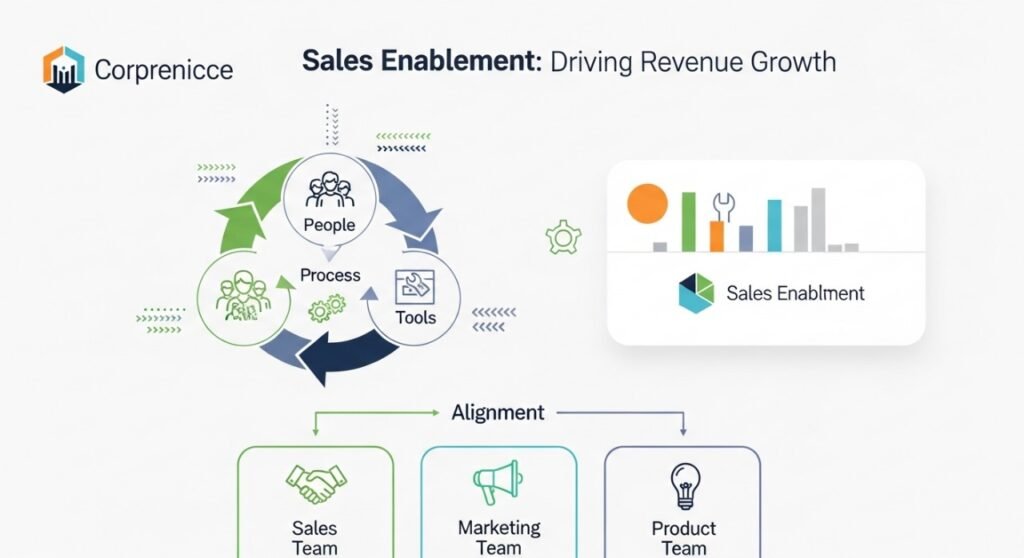
An effective sales enablement strategy requires processes that link sales, marketing, and product teams. Without that alignment, many efforts run in parallel and fail to achieve full Value.
Key alignment areas
- Shared buyer‑persona definitions: Ensure marketing and sales work from the same view of the customer.
- Unified messaging and content: Sales needs to use the same language that marketing promotes.
- Feedback loops: Sales must provide input on marketing assets, and product teams must supply updates to sales content.
- Shared metrics: Use standard dashboards that show how enablement influences the pipeline, not only how many assets were created.
According to recent metrics, companies with strong alignment achieve significantly higher win rates on forecasted deals. This demonstrates that sales enablement works best when integrated.
3. Mapping the Enablement Strategy to Revenue Metrics
To translate sales enablement into revenue, tie your framework directly to measurable business outcomes.
Revenue‑linked enablement table
| Revenue Metric | Enablement Lever | Typical Target Improvement |
|---|---|---|
| Win‑rate | Better playbooks + rep coaching | +10‑20% |
| Sales cycle length | Faster prospect‑to‑close content/tools | −15‑25% |
| Average deal size | Upsell content + value messaging | +5‑15% |
| Quota attainment | Just‑in‑time training + enablement tech | +8‑12% |
By mapping revenue metrics to enablement levers you make sales enablement accountable and actionable. This kind of table bridges strategic intent and operational execution.
4. Building the Core Enablement Toolkit
The heart of sales enablement lies in the toolkit provided to your sales representatives, including content, playbooks, training modules, and tech stack support.
Toolkit components
- Playbook library: Includes battlecards, objection‑handling, and competitor comparisons.
- Content repository: Updated, searchable assets targeted to buyer‑stage and persona.
- Training & coaching: Onboarding plus advanced sales skills, refreshed regularly.
- Technology stack: CRM, content management, analytics dashboards, and enablement platform.
When you combine these elements, sales teams can access the right asset at the right time. Effective enablement ensures that whether a rep is reaching out to a cold lead or nurturing an existing client, the support they need is available.
5. Onboarding and Continuous Development for Reps
It’s common to under‑invest in onboarding and ongoing training. Yet for sales enablement to drive revenue, your reps must be skilled and current.
- Create onboarding tracks that reduce the time to productivity and ensure new hires meet their quotas faster.
- Hold regular coaching sessions that utilize real-world scenarios and peer reviews.
- Use microlearning formats (such as short lessons and scenario practice) to keep training manageable.
- Monitor rep performance and tailor training based on gaps—this makes sales enablement targeted, not generic.
A high-performing sales team can only be enabled if it continues to learn and adapt.
6. Leveraging Technology and Data for Enablement
Modern sales enablement depends heavily on technology and analytics. Using data smartly allows enablement to measure impact and refine its approach.
- Integrate your CRM with content usage data to identify which assets are most closely correlated with closed deals.
- Use tools that provide real‑time analytics: Which email templates work? Which case studies drive conversion?
- Leverage automation to deliver content or training when reps need it (just‑in‑time enablement).
- Adopt AI or predictive tools where appropriate, but ensure they serve the process, not replace human judgment.
With properly integrated tech, your sales enablement framework becomes not just supportive but prescriptive.
7. Scaling Enablement Effectively Across Teams
Once you have proven small‑scale success with sales enablement, scaling becomes critical. You’ll want to broaden reach while preserving quality and alignment.
Scaling enablement table
| Scale Factor | Key Actions | Risk to Mitigate |
|---|---|---|
| Expanding to new regions | Localize content, adapt persona definitions | Loss of consistency across geographies |
| Serving multiple product lines | Create modular playbooks, cross‑sell tools | Team overwhelm with too‑many assets |
| Growing rep population | Use mentorship programs, tiered training | Diluted enablement‑impact for senior reps |
| Integrating partners/resellers | Shared enablement portal, co‑branded assets | Mis‑aligned messaging, brand confusion |
Scaling sales enablement without controls can lead to asset bloat, inconsistency and inefficient use of resources. Effective scale means replicability, not simply more content.
8. Monitoring, Refining, and Demonstrating Value
You cannot claim success for sales enablement unless you track results and continuously refine your approach.
- Establish a dashboard of KPIs: adoption rate of content, training completion, win‑rates, and cycle times.
- Establish a governance rhythm by conducting monthly reviews of metrics, refreshing the quarterly strategy, and performing an annual audit.
- Use rep and buyer feedback to identify pain‑points: Are assets valuable? Is training effective?
- Report outcomes to leadership in business terms: Show how enablement impacted revenue, not just assets deployed.
When enablement can prove impact, it secures investment and supports expansion.
9. Emerging Trends in Enablement and What They Mean for Revenue
As buyer behaviour and technology shift, your sales enablement strategy must also evolve to stay relevant.
- AI‑driven coaching and content personalization are increasingly becoming standard in enablement frameworks.
- Digital‑first buyer journeys mean reps need content and tools that support self‑service, virtual demos, and remote engagement.
- Data‑driven enablement—enabling teams to adapt quickly based on analytics—is no longer optional.
If your enablement strategy ignores these trends, your revenue outcomes may lag.
10. Your Next Steps to Implement Effective Enablement
To make sales enablement a revenue‑driver rather than an administrative burden, take these next steps:
- Audit your existing enablement assets and training programmes for gaps.
- Map your buyer journey and align enablement material to each stage.
- Assemble a cross‑functional enablement council to manage content, training, and metrics.
- Deploy a pilot: Select one team or region, roll out the toolkit, and track key metrics.
- Build your dashboard and review results after one quarter; refine before scaling.
When well‑executed, sales enablement shifts from optional support to a strategic engine within your revenue organisation. Across teams like those at www.careersfame.com and beyond, enabling connections to business goals makes the difference between growth and stagnation.
11. Leveraging Sales Enablement for Better Customer Engagement
Sales enablement is not only about empowering your sales team; it’s also about creating better experiences for your customers. By aligning your sales team with customer-centric strategies, you can improve engagement and build stronger relationships.
- Personalized Communication: Sales teams equipped with the right content and training can tailor their messaging based on the unique needs and pain points of each prospect. This allows for more meaningful and impactful interactions.
- Customer Insights: By utilizing data and analytics tools, sales representatives can gain deeper insights into their prospects’ behavior and interests. This enables more effective outreach and a deeper understanding of customer preferences.
- Content Delivery at the Right Time: By providing sales teams with content relevant to each stage of the customer journey, they can deliver the correct information at the right time, ensuring a seamless and personalized experience for the buyer.
The result? Increased customer satisfaction, loyalty, and ultimately, revenue. Sales enablement doesn’t just help your team sell—it helps build lasting relationships with customers.
12. The Role of Sales Enablement in Retaining Top Talent
A well-executed sales enablement strategy not only drives revenue but also contributes to employee satisfaction and retention. By empowering salespeople with the right tools, resources, and training, you create an environment that fosters their success, leading to enhanced job satisfaction and long-term growth.
- Continuous Development: Sales enablement isn’t just about onboarding new hires—it’s about continuously developing and upskilling your existing team. Providing regular training, coaching, and performance feedback shows a commitment to their professional growth.
- Job Satisfaction: When sales reps feel supported with the right resources and strategies, they’re more confident and motivated to perform at their best. This boosts morale and helps reduce turnover rates.
- Career Growth: Empowering sales reps with learning opportunities, leadership training, and career progression pathways within the organization leads to higher employee retention and satisfaction.
By focusing on sales enablement as a means to drive revenue and retain talent, you create a stronger, more sustainable team that contributes to long-term business success.
Conclusion
Effective sales enablement strategies are more than just tools and content—they are the foundation of a high-performing sales team that drives consistent and scalable revenue growth. By aligning sales, marketing, and product teams, mapping enablement efforts to key revenue metrics, and providing ongoing training and support, businesses can create an environment where sales reps thrive and succeed.
Through the thoughtful execution of the right processes, technology, and continuous learning, sales enablement empowers your team to close deals faster, increase the average deal size, and enhance customer engagement. However, the true power of sales enablement lies in its ability to adapt to changing customer needs, evolving market conditions, and new sales strategies.
Whether you’re just starting to implement sales enablement or looking to refine your current approach, it’s essential to keep a long-term perspective. The strategies outlined in this article provide a roadmap to optimize your sales processes, enhance the effectiveness of your sales team, and ultimately drive sustainable revenue growth for your organization.
By focusing on sales enablement as an ongoing initiative, businesses can position themselves for long-term success while also improving employee satisfaction and customer loyalty.
“Sales enablement applies across industries — even in luxury car sales like our recent Range Rover Velar Price overview.”
FAQs
What exactly is sales enablement?
Sales enablement refers to the systematic practice of equipping your sales team with the resources, processes, knowledge, and technologies they need to sell more effectively. It’s much more than providing content—it’s aligning people, process, and tools to drive revenue outcomes.
How does sales enablement increase win‑rates?
By ensuring reps have access to tailored content, relevant training, and real-time tools, enablement helps shorten sales cycles, improve rep confidence, and deliver consistent buyer experiences—all of which raise win rates.
Which metrics should I track to evaluate my enablement efforts?
Important metrics include content adoption rate, training completion rate, win rate, sales cycle length, average deal size, and rep quota attainment. These connections enable the activity to produce revenue outcomes.
Why is cross‑team alignment critical in sales enablement?
If sales, marketing, and product teams operate in silos, messaging and assets become inconsistent, causing friction for buyers. Alignment ensures unified messaging, efficient resource use, and smoother buyer journeys.
What’s the most prominent mistake organisations make in enablement rollouts?
One of the biggest mistakes is treating enablement as a one‑time project (create assets, deliver training, done). Instead, enablement must be ongoing, adaptive, and measurable. Without iteration and metrics, it fails to scale.