A healthy sales pipeline is the foundation of predictable revenue. Not all stages contribute equally to closing deals. Identifying the critical sales pipeline stages separates top performers from the rest. This analysis identifies the sources of revenue momentum.
Many organizations track pipeline volume without examining the efficiency of each stage. This leads to inaccurate forecasts and wasted effort. We will define the high-impact stages and their specific revenue-driving activities. This clarity helps sales teams focus on what truly matters for growth.
1. Why the sales pipeline drives revenue momentum
A pipeline shows seller actions. A funnel shows counts. That distinction matters for reviews, math, and coaching. A funnel helps you see drop-offs. A pipeline informs the team of the next steps.
Treat each stage as a contract. Entry requires evidence. Exit requires more substantial proof. Keep the list short and precise. That approach speeds cycles and removes noise from forecasts.
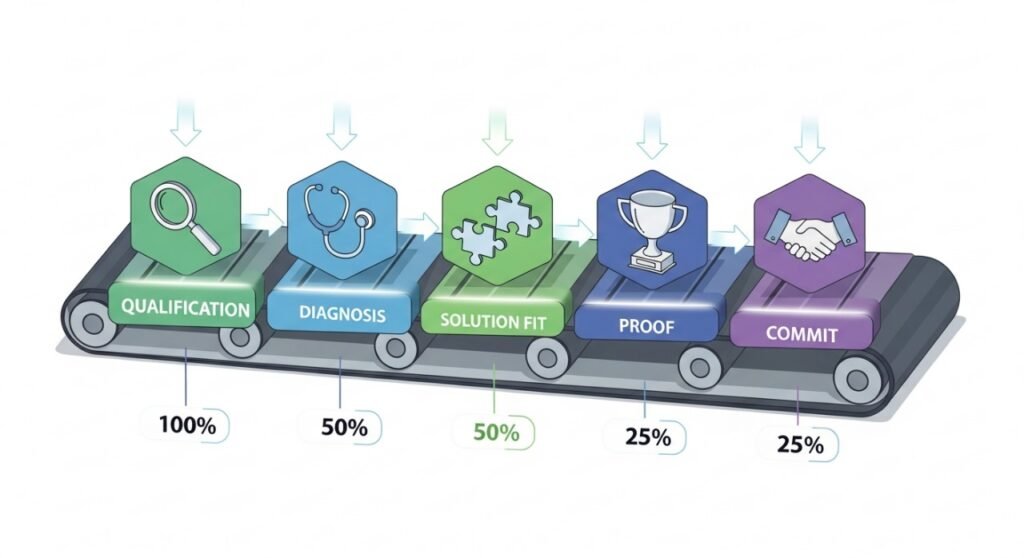
2. The five stages that actually move money
Keep stages few, crisp, and action-based. These five cover most B2B motions.
- Qualification
Confirm problem priority, access to authority, and a real timeline. - Diagnosis
Quantify impact and agree on stakes for delay. - Solution Fit
Map pains to capabilities and define success criteria. - Proof
Validate value with a pilot, demo plan, or ROI brief. - Commit
Agree on scope, commercials, and approval path.
Some teams add Nurture, Security, or Procurement as mini-stages. These can help in enterprise cycles. Start with five. Add only when a repeat blocker appears.
3. Stage criteria and exit checkpoints at a glance
Use this table as your stage contract. Keep evidence in the CRM. Tie each exit to a document or buyer action.
| Stage | Entry evidence | Exit evidence | Revenue signal | Primary owner |
|---|---|---|---|---|
| Qualification | Live discovery booked | Stakeholder confirms problem and timing | Real opportunity, not noise | SDR/AE |
| Diagnosis | Stakeholders share current state | Documented pain and impact | Problem worth paying to solve | AE |
| Solution Fit | Pains mapped to capabilities | Written success criteria and plan | Clear outcome path | AE + SE |
| Proof | Buyer accepts demo or pilot plan | Measured gain or verified fit | Price and terms confidence | AE + SE |
| Commit | Redlines start with named approvers | Executed agreement and kickoff set | Revenue booked and planned | AE + Legal |
These checkpoints prevent “stuck in stage” deals. They also reduce sandbagging and last-minute panic.
4. Qualification that protects time and price
Guard this gate. Lead count does not equal pipeline. Ask direct questions fast.
- What outcome matters most right now?
- Who owns that result? Will they meet us this week?
- What happens if the fix is delayed for 90 days?
If authority access slips, move the deal back. If timing rests on “someday,” do not advance. When the timeline depends on “someday,” do not move forward. When the budget lacks clarity, schedule an executive meeting to address the issue. You control the process—protect your time and pricing.
Coaching cues
- Record a one-sentence pain statement in the CRM.
- Note the decision date tied to a real event.
- List the approval path with names, not titles.
5. Diagnosis that arms your champion
Great reps quantify impact, not just features. Create a ‘Cost of Inaction’ note in the opportunity.
- Current cost in hours, tools, or lost revenue.
- Target outcome tied to leadership goals.
- Risk if nothing changes by a set date.
This note anchors the price later. It also provides your champion with a clear story for executives. Keep it short. Keep it specific. Review it in every deal strategy call.
Signals you want
- Stakeholders share data without delay.
- Executives react to the target outcome.
- A real deadline emerges from business risk.
6. Solution fit that aligns with executive outcomes
Convert features into outcomes using a one-page value map.
- Capability → metric moved
- Metric moved → team outcome
- Team outcome → executive goal
Share the map with your champion for edits. Ask them to circulate it. Invite pushback. Tighten the claims and the timeline. Conclude with a concise plan that identifies the owners.
Common mistakes to avoid
- Feature tours that drift from the pain.
- Jargon that hides the outcome.
- Plan phases without a success metric.
7. Pipeline math that steers decisions
Use math that guides action. Keep formulas simple. Share them in every review.
| Metric | Simple formula | Good starting target | Use it to… |
|---|---|---|---|
| Stage progression | Advanced deals ÷ deals in stage | Rising trend monthly | Spot friction early |
| Win rate | Closed-won ÷ qualified | Improve quarter over quarter | Sharpen stage rules |
| Velocity | Days from stage entry to exit | Down and steady | Catch cycle spikes |
| Coverage ratio | Pipeline value ÷ quota | Calibrate, not obey | Pair with win rate |
| Weighted pipeline | Σ deal value × stage probability | Compare to target | Thread forecast reality |
Coverage alone misleads. Pair coverage with win rate, movement, and age. Weight deals by stage and by time in stage. Watch velocity. Slow movement with high value often signals discount risk.
Practical review moves
- Highlight stage pairs with the worst progression.
- Coach two skills that lift those transitions.
- Publish a short summary for the field by Friday.
8. Proof that builds conviction, not drag
Run a demo plan, pilot, or proof brief with a tight scope. Keep momentum high.
- One success metric that leadership values.
- One buyer dataset or workflow.
- Weekly checkpoint with a named owner.
Require the buyer to supply data or time. That skin in the game predicts a real deal. Avoid endless pilots that drain energy and blur value. Time-box every proof. Tie it to a clear, near-term decision.
Template you can reuse
- Objective: improve metric X by Y% in two weeks.
- Scope: one workflow, one team, one dataset.
- Schedule: three checkpoints, one final readout.
- Owner: name and role on both sides.
9. Commit stage without last-minute surprises
Map approvals before redlines start. Treat this like project planning.
- Legal clauses that block momentum.
- Security reviews and data terms.
- Procurement systems and vendor setup.
- Executive sponsor for tie-breaking.
Add these names to the opportunity. Schedule a final call while the redlines are running. Share a short close plan with both teams. Ask for a target signing date. Manage the calendar with intent.
Close plan bullets
- Who signs and in what order?
- Which clauses often stall?
- What events might slip the date?
- How both teams handle delays.
10. Review rhythm leaders use every week
Hold two sessions. Keep them short and sharp.
- Hygiene scrub: Close lost or recycle stale records. Remove anything without exit evidence.
- Deal strategy: Coach the top opportunities. Confirm the following actions and owners.
Use a simple meeting deck each week. Include stage movement charts, not only totals. Call out one win and one miss per stage. Capture three actions before ending the call.
Meeting norms that help
- Reps share data, not stories.
- Managers coach actions, not opinions.
- Everyone leaves with clear next steps.
11. Variations by industry and motion
Different motions need minor tweaks. Keep the core stages intact.
- PLG or low-ACV: Compress to three or four stages. Use short Proof steps.
- Enterprise: Insert Security and Procurement as mini-stages. Map approvals during Qualification.
- Services: Replace Proof with a Paid Workshop or Trial SOW.
- Channel: Track two stakeholder maps and separate exit rules.
These edits respect cycle length and buyer risk. They also keep your CRM clean.
12. A 30-day playbook to reset your pipeline
Frist Week : Stage audit
- Delete labels that mirror tasks, not progress.
- Draft entry and exit evidence for the five stages.
- Add rotting days for each stage.
Second Week : Field design
- Add three required fields per exit.
- Build templates for value maps and demo plans.
- Train with three real opportunities.
Week 3: Hygiene and rebuild
- Close out stale deals without proof of exit.
- Rebuild coverage with targeted sequences.
- Reconfirm authority paths on active deals.
Week 4: Inspect and coach
- Review stage movement, not totals.
- Highlight one win and one miss per stage.
- Publish the following actions for every large deal.
This four-week run cuts noise fast. It also aligns managers and reps on the same signals.
13. CRM fields that make stages work harder
Place required fields at exits only. Keep forms short. Capture proof, not trivia.
- Qualification exit: pain statement, authority path, date pressure.
- Diagnosis exit: quantified impact, decision steps, target metric.
- Solution Fit exit: success criteria, plan owner, proof start date.
- Proof exists: measured gain, executive validation, pricing status.
- Commit exit: final scope, approver list, kickoff date.
Add stage-age dashboards. Escalate deals that rot beyond your norms. Managers should intervene early, not at quarter-end.
14. Common traps and quick fixes
- Over-qualification: Deals added to hit coverage. Fix with strict exits.
- Solution drift: Feature tours without outcomes. Fix with a value map.
- Pilot bloat: Trials without time boxes. Fix with a tight plan.
- Approval surprises: Late blockers appear. Fix with early mapping.
Write these traps on the review agenda. Ask reps to flag risks as they appear. Celebrate clean exits and quick disqualifications.
15. What this means for your forecast
Coverage appears to be fine until age and movement indicate otherwise. Treat 3× as context, not a rule. Blend coverage, win rate, velocity, and stage conversion. That mix reveals risk early. It also makes quarter calls steadier.
Weighted pipeline helps you stay honest. Weight deals are categorized by stage and by time within each stage. Pull out aged deals that lack exit proof. Focus energy on opportunities that move each week.
A simple forecast lens
- Is stage progression rising across the board?
- Do we see faster velocity without new discounts?
- Are we winning more from Proof to Commit?
- Do the weighted totals align with the target?
If the answer trends yes, your calls will land closer to reality.
Conclusion
Your sales pipeline should mirror the buyer’s progress and the seller’s proof. Five stages drive most revenue momentum: Qualification, Diagnosis, Solution Fit, Proof, and Commit. Keep entry and exit rules tight. Log evidence, not opinions. Coach to stage movement and velocity, not only totals. Pair coverage with conversion and age. Favor weighted views for forecast calls. This approach shortens cycles and steadies cash flow. For templates and checklists, you can browse resources at www.careersfame.com.
“For more strategies and tips on improving sales, check out our Sales section.”
FAQs
How many stages should my team run?
Start with five. Add mini-stages only when the same blocker repeats. Short lists improve data quality and speed. Your team will also coach more effectively.
How do I set stage probabilities without guessing?
Use your own history. Calculate conversion rates by adjacent stages. Update weights each quarter as patterns change. Keep a record of those changes.
What’s the difference between a pipeline and a funnel?
A pipeline tracks seller actions and next steps. A funnel counts prospects by step. Manage actions in the pipeline. Use the funnel to view drop-offs.
Do I still need 3× coverage?
Treat it as a starting point. Coverage without win rate, age, and velocity misleads. Pair these metrics, and you will read risk earlier.
How often should I scrub the pipeline?
Run a weekly hygiene pass and a separate strategy session. Keep both short. Close or recycle deals that lack exit evidence. Publish next steps before you end.